
Today, most people barely think about time zones. Phones update automatically, flights are coordinated globally, and Ireland shares the same clock as the UK during winter.
But Ireland once had its own unique national time zone, and for decades the clocks in Dublin were officially 25 minutes and 21 seconds behind London.
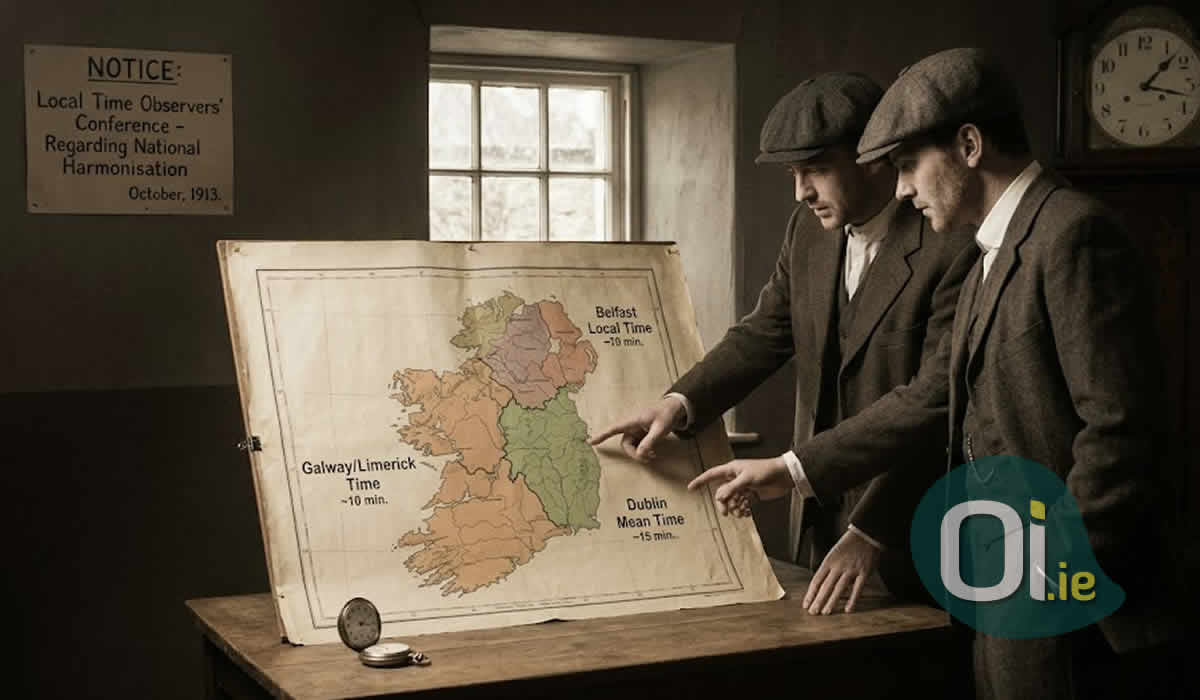
Even stranger, before standardised national time existed, different parts of Ireland effectively operated on slightly different local times depending on the position of the sun.
For a period in history, Ireland quite literally ran on its own time.
Before Standardised Time, Every Town Had Its Own Clock
Before railways and telegraphs became widespread during the 19th century, time was determined locally.
Noon simply meant the moment when the sun reached its highest point in the sky for that particular location. Because the sun reaches different parts of Ireland at slightly different moments, every town effectively had its own local time.
Places further west experienced sunrise and sunset slightly later than places in the east.
For example, local solar time in Galway was several minutes behind Dublin, while towns in Cork and Kerry also operated slightly later than eastern parts of the country.
In practice, most people barely noticed. Travel was slow, communication was limited, and local timing was good enough for daily life.
That changed rapidly with the arrival of railways.
The Railway Problem
As train networks expanded across Ireland and Britain during the 1800s, local timekeeping became increasingly impractical.
A train timetable could become chaotic if every town used its own clock. Telegraph operators, shipping companies and businesses also needed standardised schedules.
Britain began moving toward Greenwich Mean Time, based on the Royal Observatory in Greenwich, London.
Ireland, however, chose its own standard.
What Was Dublin Mean Time?
Ireland officially adopted Dublin Mean Time, usually shortened to DMT.
The system was based on solar time at the Dunsink Observatory near Dublin.
Because Dublin lies west of London, Dublin Mean Time was 25 minutes and 21 seconds behind Greenwich Mean Time.
That meant when it was exactly 12:00 in London, it was officially 11:34:39 in Dublin.
To modern readers, the oddly specific difference sounds absurd, but at the time it was considered scientifically precise.
Did Ireland Have Multiple Time Zones?
Technically, yes, but not in the modern sense of officially recognised time zones with borders.
Before Dublin Mean Time became standardised nationally, every area in Ireland followed its own local solar time.
Here are some approximate examples of how local times differed across the island compared with Greenwich Mean Time:
| Location | Approximate Local Time Difference from GMT | Compared with Dublin |
|---|---|---|
| Dublin | GMT – 25 minutes 21 seconds | Reference point for Dublin Mean Time |
| Galway | Approximately GMT – 38 minutes | About 13 minutes behind Dublin |
| Cork | Approximately GMT – 33 minutes | About 8 minutes behind Dublin |
| Belfast | Approximately GMT – 22 minutes | About 3 minutes ahead of Dublin |
| Donegal (western areas) | Approximately GMT – 40 minutes | Roughly 15 minutes behind Dublin |
These were not official political time zones, but they were real differences in local solar time.
If standardisation had never happened, travelling from Belfast to western Donegal could theoretically have meant adjusting your watch by nearly 20 minutes.
Why Ireland Did Not Simply Use London Time
The use of Dublin Mean Time reflected more than geography.
During the 19th century, many countries used national observatories as their reference points for timekeeping. Britain used Greenwich, France used Paris, and Ireland used Dunsink.
The idea that Ireland would naturally follow London’s clock was not universally accepted at the time.
Maintaining Dublin Mean Time also reflected a degree of administrative independence within the United Kingdom of Great Britain and Ireland.
The End of Dublin Mean Time
Dublin Mean Time officially ended in 1916 under the Time (Ireland) Act.
Ireland aligned with Greenwich Mean Time, bringing the island into sync with Britain.
The timing was historically significant. The change happened during the same year as the Easter Rising.
After that, the famous 25-minute difference disappeared permanently.
Ireland’s Modern Time System
Today, Ireland follows Greenwich Mean Time during winter and Irish Standard Time during summer daylight saving months.
That means Ireland actually operates one hour ahead of GMT during summer.
Debates about Irish time occasionally still emerge, particularly around darker winter mornings and discussions about European time alignment after Brexit.
However, a return to a uniquely Irish national time zone remains highly unlikely in the modern world.
Quick Timeline of Irish Timekeeping
| Year | Event | Learn More |
|---|---|---|
| Pre-1800s | Irish towns use local solar time | Learn more |
| 1880 | Dublin Mean Time becomes official across Ireland | Learn more |
| 1916 | Ireland switches to Greenwich Mean Time | Learn more |
| Modern era | Ireland uses GMT in winter and Irish Standard Time in summer | Learn more |
For many people today, the idea of Ireland being 25 minutes behind Britain sounds almost fictional. Yet for decades it shaped railway timetables, shipping schedules, business operations and daily life across the island.
It is also a reminder that time zones are not fixed laws of nature. They are human inventions shaped by science, politics, geography and history.
And for a surprisingly long period, Ireland had its own distinctly Irish way of measuring time.


