


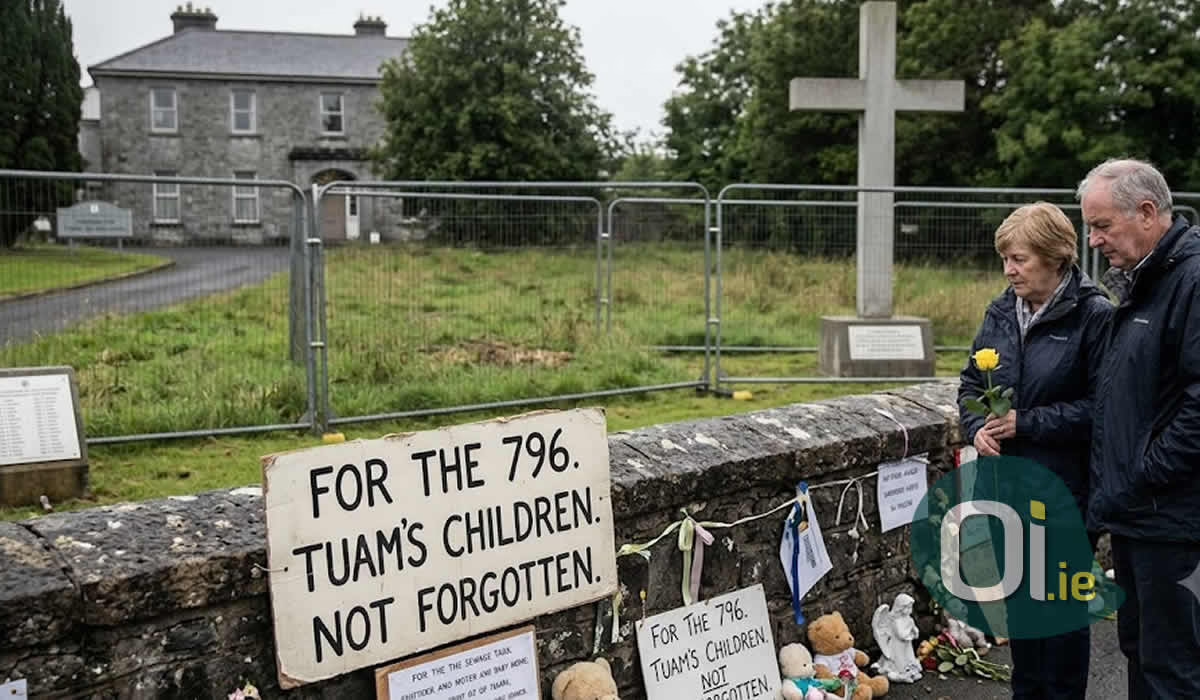
Few discoveries in modern Irish history have shocked the nation as profoundly as what was uncovered in Tuam, County Galway. What began as the determined research of one local historian exposed a hidden chapter of Ireland’s past that many believed had been forgotten forever.
The discovery of hundreds of children’s remains at the site of the former Bon Secours Mother and Baby Home forced Ireland to confront decades of secrecy, institutional failure and the treatment of unmarried mothers and their children. It also sparked an international conversation about historical accountability, human rights and the lasting impact of social stigma.
Today, Tuam stands not only as a place of remembrance, but also as a symbol of Ireland’s continuing effort to understand and acknowledge one of the darkest periods in its modern history.
What Was the Tuam Mother and Baby Home?
The Bon Secours Mother and Baby Home operated in Tuam, County Galway, from 1925 until 1961. It was managed by the Bon Secours Sisters while functioning within Ireland’s wider system of institutions for unmarried mothers.
During much of the twentieth century, women who became pregnant outside marriage often faced severe social condemnation. Many families, fearing public shame, sent daughters to mother and baby homes where they remained during pregnancy and childbirth.
Once admitted, many women worked within the institution while awaiting the birth of their child. Some babies remained with their mothers for a period before being separated through adoption or foster arrangements, while others spent time in institutional care.
Although these homes were intended to provide shelter, many suffered from overcrowding, poor sanitation, limited healthcare and inadequate nutrition, contributing to exceptionally high infant mortality rates.
Catherine Corless and the Discovery That Changed Everything
The turning point came through the work of local historian Catherine Corless.
While researching local records, Corless discovered death certificates for 796 children who had died at the Tuam home between 1925 and 1961. However, despite extensive research, she was unable to locate burial records for the overwhelming majority of those children.
Her investigation suggested that many of the children had been buried in an underground structure located on the former institution’s grounds, an area believed to have originally been part of a disused sewage or septic system.
When her findings became public in 2014, they generated international headlines and prompted calls for a full government investigation.
Forensic Investigation Confirms Human Remains
In response to growing public concern, the Irish Government established a Commission of Investigation into Mother and Baby Homes.
Between 2016 and 2017, forensic experts excavated parts of the Tuam site.
Their findings confirmed the presence of large quantities of human remains within underground chambers. Scientific analysis showed that the remains belonged to infants and young children ranging from approximately 35 weeks’ gestation to around three years of age.
The discovery confirmed that the location had been used as an undocumented burial site connected to the former institution.
Although the investigation did not conclude that every child had been deliberately buried without dignity, it demonstrated that the burial arrangements fell far below modern expectations and highlighted significant historical failures in record-keeping and institutional oversight.
Why Did So Many Children Die?
Infant mortality throughout Ireland during the early twentieth century was considerably higher than it is today. However, the mortality rates recorded in many mother and baby homes exceeded those found in the general population.
Among the most common causes of death recorded were:
- Measles
- Pneumonia
- Gastroenteritis
- Tuberculosis
- Respiratory infections
- Malnutrition
- Premature birth
- Congenital illnesses
Medical experts have pointed to overcrowding, poor hygiene, inadequate nutrition and limited medical resources as major contributing factors.
The Commission also found evidence that institutional conditions often failed to meet acceptable standards of care for vulnerable mothers and children.
Ireland’s National Reckoning
The Tuam revelations prompted one of the most significant examinations of Ireland’s institutional history.
The Commission of Investigation examined 18 mother and baby homes and several county homes across Ireland.
Its final report, published in 2021, estimated that approximately 9,000 children died in these institutions between 1922 and 1998.
The report concluded that discrimination against unmarried mothers permeated Irish society for decades and that both State authorities and religious institutions played important roles within that system.
Rather than assigning responsibility to a single organisation, the report described a broader societal failure involving government policy, religious organisations, local authorities and prevailing public attitudes.
Official Apologies
Following publication of the Commission’s findings, Taoiseach Micheál Martin issued a formal apology on behalf of the Irish State.
He acknowledged that Ireland had failed thousands of vulnerable women and children and described the country’s treatment of unmarried mothers as a profound national shame.
The Bon Secours Sisters also apologised publicly, expressing deep sorrow for the suffering experienced by mothers and children who had lived in their care.
Survivor groups welcomed the acknowledgements while continuing to campaign for greater access to historical records, accountability and support services.
The Ongoing Excavation
The story did not end with the Commission’s report.
Specialist forensic teams have begun the painstaking process of excavating the Tuam site with the objective of recovering, identifying where possible and respectfully reburying the children’s remains.
The work presents enormous scientific challenges due to the age of the remains, the condition of the burial chambers and the commingling of skeletal material over many decades.
DNA testing is expected to identify some children, although many families may never receive definitive answers.
Why Tuam Still Matters
The Tuam investigation has become one of the defining moments in Ireland’s modern social history.
It has encouraged broader discussions about institutional abuse, historical transparency, women’s rights, children’s welfare and the importance of preserving historical records.
For many survivors and relatives, the search for truth remains unfinished. Access to personal files, adoption records and family histories continues to be an important issue for thousands of people affected by Ireland’s former institutional system.
The story has also become an international case study in how societies confront painful historical injustices while attempting to balance accountability, evidence and reconciliation.
Remembering Those Lost
Behind every statistic lies a child whose life ended far too soon and a mother whose experiences were often shaped by fear, shame and social exclusion.
The Tuam Mother and Baby Home has become a powerful reminder of the human cost of institutional neglect and societal prejudice.
As forensic investigations continue and families search for answers, Ireland continues its difficult journey towards acknowledging its past with honesty, compassion and respect for those whose voices went unheard for generations.
Remembering what happened in Tuam is not simply about revisiting history. It is about ensuring that future generations understand the consequences of silence, stigma and institutional failure, and why dignity and accountability must always remain at the heart of public life.


