
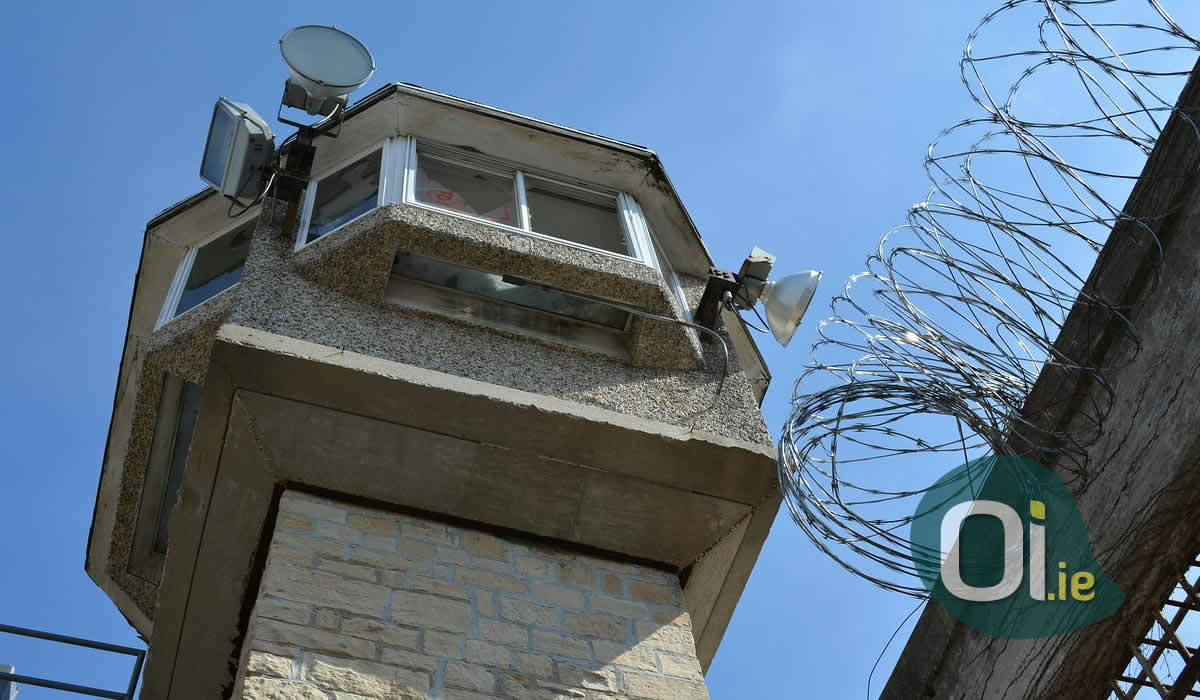
There’s no end in sight. With bad government management, and a lack of reform and a compete disregard for future planning, Irish prisons are putting violent criminals back on the streets in Ireland. Some repeat offenders are released 1 day into lengthy sentences.
- Over 1,000 prisoners last year were released from prison within 24 hours of being admitted.
- Violent repeat offenders are being released early, despite being multiple time offenders.
- As of May 2025, Ireland’s prison population was approximately 6,129 inmates, against a design capacity of 4,666 beds, operating at around 115 % capacity.
Early Release: How It Works & Scope
- In March 2023, eligibility for temporary release (often permanent early release) was significantly broadened to include those serving under a year, or with less than a year remaining – leading to a major uptick in usage.
- By mid‑2024, average numbers on temporary release rose to around 500, a ~60% increase from before the rule change. In May 2025, there were 595 prisoners free under such schemes – roughly double the numbers seen two years earlier.
- In some cases, individuals sentenced to 18-month terms have been released after just four weeks including drug‑related offenders, domestic violence offenders and gang members.
Notable Examples
- Stephanie Treacy, from Limerick: convicted for an organised drug operation, set for an 18‑month sentence, served only four weeks before early release under overcrowding policies. Her brother remained incarcerated.
- Mary Higgins, a former school bursar: sentenced in June 2025 to one year in prison for financial fraud (€500k), but released after about three weeks from Dublin’s Mountjoy/Dochas centre due to overcrowding. There were ~5,508 inmates at the time, in facilities with capacity for only 4,672 beds.
- In Cork Prison (2006), 45 prisoners were reportedly released up to three to four months early to make room following new admissions, illustrating that the “revolving door” problem is longstanding.
The temporary release myth
So-called temporary release is a system in theory to allow prisoners short-term freedom from custody, however, this now means they have been freed early and are not obliged to return to prison. In May 2025 the number of prisoners currently on temporary release is 595.
The Lack of Prison Spaces & Responses
The Irish government has stated they are working to alleviate some of the pressures, although there has been very little forward planning for some time now, and very little reform. The following are some actions being taken or considered:
- Temporary release: The Prison Service utilizes temporary release, allowing prisoners to be released from custody for a period of time, effectively shortening their sentences.
- A Prison Overcrowding Response Group: A Prison Overcrowding Response Group was established in mid‑2023, delivering recommendations including structured temporary release schemes, expanded use of community service orders (CSOs), and better use of the Probation Service.
- New prison spaces: The government announced plans to deliver around 1,100 new prison beds by 2030, with 620 spaces approved in 2023 and some 200 already added, though capacity remains deeply strained. This isn’t near the amount required, in particular given the huge increase of Ireland’s population.
- Extending community service as an alternative to prison:Justice Minister Jim O’Callaghan has proposed increasing the threshold for community service orders from 12 to 24 months, and doubling the maximum service hours from 240 to 480 hours. Electronic tagging is also planned to be rolled out by the end of the year The Times.
- Extending bail options: There are proposals aiming to extend bail supervision schemes to female and youth offenders, easing pressure on women’s prisons like Dóchas Centre, currently well above capacity. The idea is to keep low‑risk offenders out of prison altogether where feasible.
What percentage of Irish prisoners are foreign born?
Based on the most recent available data in 2024, non-Irish nationals constitute roughly 17.2% of the total prison population in the Republic of Ireland.
This is derived from statistics provided by the Irish Prison Service for September 30, 2024, which indicated that out of 4,975 individuals in custody, 856 were of a “Non-Irish Nationality Group.”
A sad reflection
Despite efforts to address prison overcrowding, meaningful change remains elusive. With offenders carrying over 300 convictions still walking Ireland’s streets, the country’s safety is compromised, and the challenge of balancing justice and public security continues to grow.


