


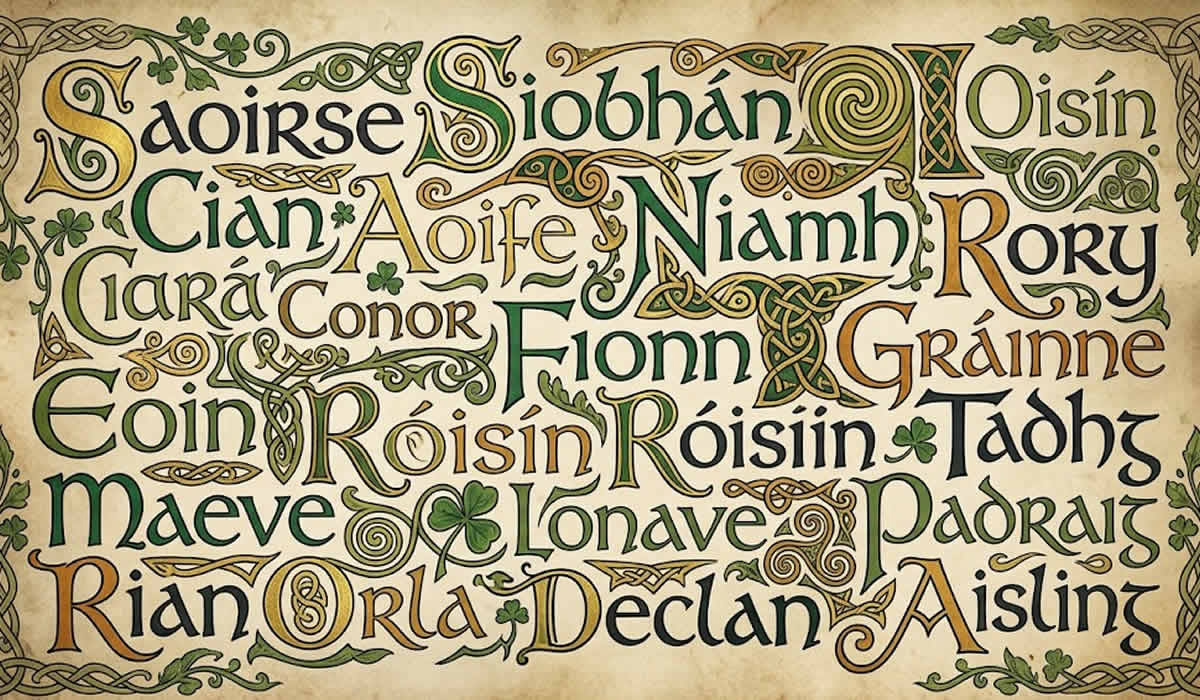
From Aoife and Saoirse to Cillian and Tadhg, Irish names are rich in history, mythology and meaning. Here are some of the most interesting traditional Irish names, what they mean and how to pronounce them.
Irish names have a distinctive character, shaped by centuries of Celtic mythology, Gaelic language and Irish history. While some can seem difficult to pronounce at first glance, many have beautiful meanings and fascinating stories behind them.
From names inspired by ancient Irish legends to those associated with freedom, beauty, wisdom and strength, traditional Irish names offer parents a way to celebrate the country’s cultural heritage.
They are also a reminder of the differences between Irish and English spelling conventions. Names such as Aoife, Niamh and Tadhg may look unfamiliar to people who have not encountered the Irish language before, but their pronunciation follows patterns that make sense within Irish.
Here are some traditional Irish names for boys and girls, along with their meanings, pronunciation guides and the stories behind them.
Traditional Irish girls’ names and their meanings
1. Aoife
Pronunciation: EE-fa
Aoife is one of Ireland’s best-known traditional girls’ names. It is commonly associated with beauty and is often interpreted as meaning “beautiful” or “radiant”.
In Irish mythology, Aoife was the name of a formidable female warrior. One of the best-known stories features Aoife of Alba, who fought against the warrior Cú Chulainn and was eventually defeated by him.
The name combines a short, distinctive spelling with a pronunciation that often surprises visitors to Ireland.
2. Saoirse
Pronunciation: SEER-sha
Saoirse means “freedom” or “liberty” in Irish, giving it a particularly powerful meaning.
The name became especially prominent in modern Ireland and is widely associated with Irish identity and independence. Its international profile has also grown through Irish actress Saoirse Ronan.
For parents looking for a name with a strong cultural connection and a clear symbolic meaning, Saoirse is an appealing choice.
3. Niamh
Pronunciation: NEEV
Niamh is a name deeply rooted in Irish mythology. It is usually interpreted as meaning “bright” or “radiant”.
In the legend of Tír na nÓg, Niamh Chinn Óir, whose name means Niamh of the Golden Hair, takes the legendary hero Oisín to the Land of Youth. The story remains one of the best-known romantic tales in Irish mythology.
The name is also a good example of Irish spelling conventions, with the combination of “mh” producing a sound similar to the English “v”.
4. Siobhán
Pronunciation: shi-VAWN
Siobhán is the Irish form of Joan and is ultimately related to the name Jane. Its deeper meaning is connected to the Hebrew name Yochanan, commonly interpreted as “God is gracious”.
It has been popular across generations in Ireland and remains recognisably Irish without being confined to any particular period.
5. Róisín
Pronunciation: roh-SHEEN
Róisín means “little rose”, making it one of the most straightforwardly poetic Irish names.
The name also has a strong place in Irish literature and political symbolism. The figure of Róisín Dubh, meaning “Little Dark Rose”, appears in traditional Irish poetry and songs and has often been interpreted as a symbolic representation of Ireland.
6. Fiadh
Pronunciation: FEE-ah
Fiadh is associated with the Irish word for a wild or untamed animal and is often interpreted in the context of wildness, nature and the natural world.
It has become a particularly prominent choice among modern Irish parents, reflecting a wider interest in short Gaelic names with a strong connection to Irish heritage.
Its simple pronunciation contrasts with a spelling that may be unfamiliar to people outside Ireland.
7. Caoimhe
Pronunciation: KEE-va or KWEE-va
Caoimhe comes from the Irish word caomh, associated with gentleness, kindness and beauty. Its meaning is often given as “gentle” or “beautiful”.
The pronunciation varies by region and family tradition, with both KEE-va and KWEE-va commonly encountered.
It is a distinctly Irish name that combines a traditional Gaelic spelling with a soft sound.
8. Clodagh
Pronunciation: KLOH-da
Clodagh is associated with the River Clodagh, a name shared by several rivers in Ireland. Its origin is less certain than the meanings of some other names on this list.
The name became established as a girls’ name in Ireland and has a strong connection to the Irish landscape.
9. Eimear
Pronunciation: EE-mer
Eimear is a traditional Irish name often interpreted as meaning “swift” or “ready”. Its most famous mythological association is Eimear, the wife of Cú Chulainn.
In Irish legend, Eimear is celebrated for possessing six qualities of womanhood, including beauty, wisdom, voice and skill in needlework. The story gives the name a connection to intelligence and accomplishment as well as beauty.
10. Bríd
Pronunciation: breed
Bríd is the Irish form of Bridget, a name associated with Saint Brigid of Kildare, one of Ireland’s patron saints.
The name is also linked to the pre-Christian goddess Brigid, associated with poetry, healing and craftsmanship. The exact historical relationship between the goddess and the later Christian saint is complex, but both occupy an important place in Irish cultural tradition.
Bríd remains a strong choice for families wishing to honour Irish history and tradition.
Traditional Irish boys’ names and their meanings
1. Cillian
Pronunciation: KIL-ee-an
Cillian is a popular Irish boys’ name with historic religious associations. It is commonly interpreted as meaning “little church” or “associated with a church”, although its precise etymology is debated.
The name is associated with Saint Kilian, an Irish missionary who travelled to continental Europe in the seventh century.
Cillian has also gained international recognition through Irish actor Cillian Murphy, helping make the name familiar far beyond Ireland.
2. Tadhg
Pronunciation: TIEG, rhyming with “vague” without the initial v
Tadhg is an ancient Irish name traditionally associated with a poet, storyteller or philosopher. It is often translated as “poet” or “bard”.
The name appears throughout Irish history and medieval literature, including the names of Irish kings and nobles. It is also the origin of the older English-language word “Tory”, although the political term developed through a separate historical context.
Tadhg is one of the clearest examples of how Irish pronunciation can differ dramatically from what an English speaker might expect from the spelling.
3. Oisín
Pronunciation: uh-SHEEN
Oisín means “little deer” and is one of the most famous names in Irish mythology.
He was the son of the legendary warrior Fionn mac Cumhaill and a central figure in the Fenian Cycle of Irish stories. Oisín is particularly associated with the tale of Tír na nÓg, in which he travels to the Land of Youth with Niamh.
The name combines an animal-inspired meaning with one of Ireland’s best-known legendary figures.
4. Fionn
Pronunciation: FYUN or FYUNN, with regional variation
Fionn is associated with fairness, brightness and light-coloured hair. It is best known through Fionn mac Cumhaill, the legendary leader of the Fianna, a band of warriors in Irish mythology.
According to legend, Fionn gained extraordinary wisdom after tasting the Salmon of Knowledge. The story remains a familiar part of Irish folklore.
The name is also related to the anglicised form Finn.
5. Cian
Pronunciation: KEE-an
Cian is a traditional Irish boys’ name meaning “ancient” or “enduring”.
In Irish mythology, Cian was the father of Lugh, one of the most important figures in the stories of the Tuatha Dé Danann. The name has survived across centuries and remains popular in contemporary Ireland.
Its short spelling and relatively straightforward pronunciation have helped it become familiar internationally.
6. Dáithí
Pronunciation: DAW-hee
Dáithí is a traditional Irish name commonly associated with the meaning “swift” or “nimble”, although its precise origin is debated.
It is an established Irish name with historical associations, including Dáithí, a figure traditionally identified as a king of Ireland.
The fada over the “á” indicates a long vowel, while the “th” combination in Irish is pronounced differently from the English “th” sound.
7. Seán
Pronunciation: SHAUN
Seán is the Irish form of John, ultimately derived from the Hebrew name Yochanan and commonly interpreted as “God is gracious”.
It has been one of the most enduring boys’ names in Ireland, appearing across generations and in Irish literature, politics and public life.
The fada over the “á” changes the vowel sound and is an important part of the correct spelling.
8. Conor
Pronunciation: KON-er
Conor is an anglicised spelling of the Irish name Conchobhar, which has ancient royal and mythological associations. Its exact meaning is uncertain, although interpretations linking it to desire or the love of hounds are sometimes offered.
Conchobhar mac Nessa, the legendary king of Ulster, is one of the best-known figures associated with the original Irish form.
Conor remains a familiar Irish name that is easy to pronounce in many languages.
9. Lorcán
Pronunciation: LOR-kawn
Lorcán is commonly interpreted as meaning “little fierce one” or “little warrior”, although explanations of its precise etymology vary.
The name is particularly associated with Saint Laurence O’Toole, whose Irish name was Lorcán Ua Tuathail. He served as Archbishop of Dublin in the twelfth century and played an important role during a turbulent period in Irish history.
Lorcán offers a traditional alternative to more widely used Irish boys’ names.
10. Ruaidhrí
Pronunciation: ROO-ree
Ruaidhrí is an old Irish name often translated as “red king”. It is related to the anglicised names Rory and Roderick.
One of its most notable historical bearers was Ruaidrí Ua Conchobair, or Rory O’Connor, the last high king of Ireland before the Anglo-Norman invasion.
The name is a strong example of the connection between traditional Irish names and the country’s royal history.
Why Irish names can be difficult to pronounce
Irish spelling follows its own rules, rather than the conventions of English. Once a few of these rules are understood, many traditional names become much easier to read.
One important feature is the use of slender and broad consonants, determined partly by the vowels surrounding them. This helps explain why Irish letter combinations can produce sounds that seem unexpected to English speakers.
The letter combinations “bh” and “mh” often sound like a “v” or “w”, depending on the word and dialect. The combinations “dh” and “gh” can represent sounds ranging from a soft consonant to a sound that is barely audible. Meanwhile, “ao” and “ae” can produce vowel sounds that do not have direct equivalents in English.
The fada, the accent mark seen in names such as Seán, Róisín and Dáithí, indicates a long vowel. It is not merely decorative and should be retained when spelling the name correctly.
Pronunciation can also vary between Irish-speaking regions, particularly in the differences between Munster, Connacht and Ulster Irish. The guides in this article are practical approximations rather than a substitute for hearing a name spoken by its bearer.
Irish names offer a connection to the country’s history
Traditional Irish names are much more than unusual spellings. Many preserve stories of legendary warriors, ancient kings, saints and characters whose adventures have been passed down through generations.
Names such as Saoirse carry an association with freedom, while Róisín connects to poetry and Irish symbolism. Oisín and Fionn draw on the country’s rich mythology, and Tadhg preserves a linguistic connection to Ireland’s tradition of poetry and storytelling.
Whether chosen for their meanings, their sound or their family significance, Irish names offer a way to carry a part of the country’s language and cultural heritage into the next generation.


