


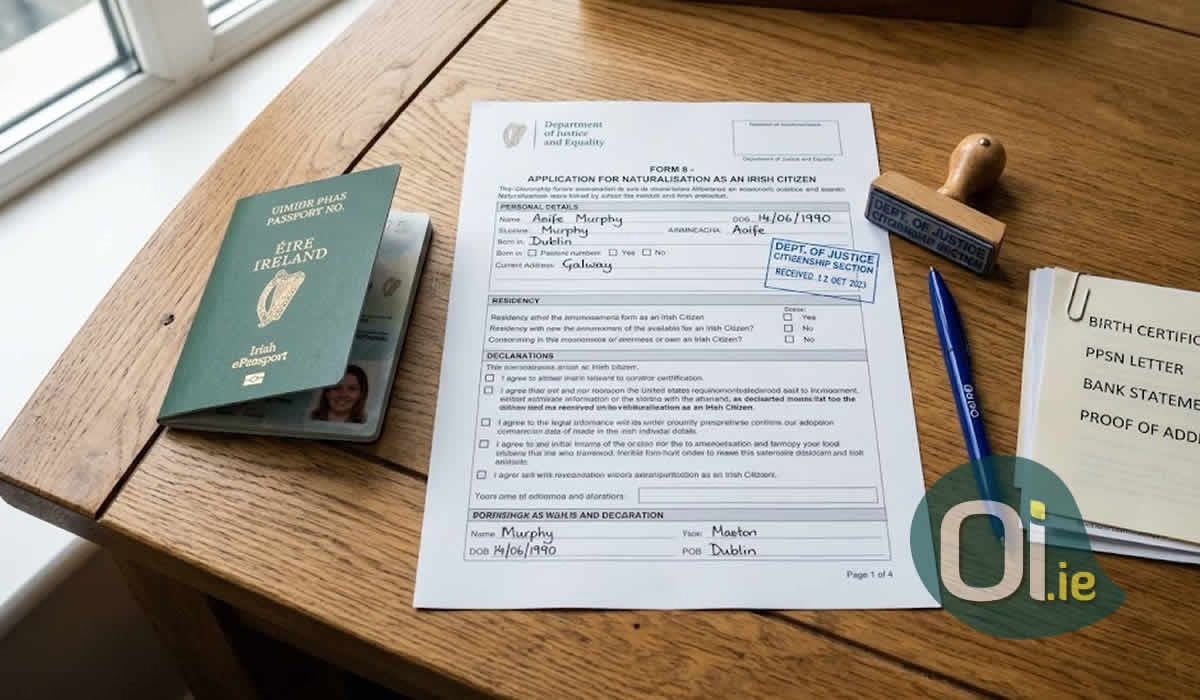
Ireland is preparing to make becoming an Irish citizen considerably more demanding. The Government’s proposed overhaul could increase the standard residence requirement from five to eight years, introduce language and civics tests, and require applicants to demonstrate financial self-sufficiency.
For immigrants who have spent years building a life in Ireland, the central question is whether the changes will apply only to people arriving in the future or whether existing residents will also be affected. The answer is important: the proposals are not limited to new arrivals, and the date someone applies may matter more than the date they first moved to Ireland.
The proposals come amid growing debate about immigration, integration, housing and pressure on public services. The Government says naturalisation should reflect sustained lawful residence, economic self-sufficiency, social integration and compliance with immigration law, rather than simply the passage of time.
What are Ireland’s proposed new citizenship rules?
On 9 September 2026, the Government approved priority drafting of the Irish Nationality and Citizenship (Amendment) Bill 2026. The General Scheme, published on 21 September, outlines proposed changes to the naturalisation system, but it is not itself a law and the detailed provisions may change as the legislation progresses.
The main proposals include increasing the standard residence requirement from five to eight years, introducing tests in English, Irish or Irish Sign Language, adding a test on Irish civics, society and politics, and requiring applicants to meet financial self-sufficiency conditions. The proposals would also tighten aspects of the good-character requirement and address certain immigration offences.
Read the Government announcement on the citizenship proposals and the current naturalisation guidance.
Will the new rules only affect people arriving in Ireland after 2026?
No. The proposals are not designed solely for people who arrive after the legislation takes effect. The Government has indicated that applications made after commencement would be assessed under the law then in force, which means an immigrant who has already lived in Ireland for several years but has not yet applied could also face the new requirements.
For example, someone who arrived in Ireland in 2022 might expect to reach the current five-year residence threshold in 2027. If the new rules have commenced before that person submits an application, the proposed eight-year requirement could delay their eligibility until 2030, assuming their residence is reckonable and they meet the other conditions.
This would not restart their immigration history or automatically affect their permission to live and work in Ireland. It would change the conditions for applying for citizenship, potentially extending the wait for people who are already resident in the State.
What if I have already applied for citizenship?
The Minister of State said in a Dáil response on 15 October 2026 that applications would continue to be assessed under the existing provisions of the Irish Nationality and Citizenship Act 1956 until the new legislation is passed, signed and enacted. The General Scheme also contains transitional wording on certain changes to residence that does not count, but it does not clearly settle every possible issue for applications that remain undecided when the new rules commence.
That means applicants who have already submitted an application should not assume that every proposed change will apply to them, but neither should they rely on broad assurances that every part of their application is protected. The final Bill and any commencement or transitional provisions will need to be checked once published.
Applicants who qualify under today’s rules but have not yet applied are in a different position. The Minister has indicated that applications made after commencement will be assessed under the law then in force, so someone who qualifies under the five-year system could still be affected if they wait until after the new rules begin.
How will the eight-year residence requirement work?
Under the current rules for most adult applicants, a person generally needs one continuous year of residence immediately before applying, plus four years of reckonable residence during the preceding eight years. This is commonly described as five years of reckonable residence.
The proposed system would require two continuous years immediately before applying, plus six additional years within the preceding ten-year period. The table summarises the proposed change.
| Requirement | Current rules | Proposed rules |
|---|---|---|
| Total reckonable residence | 5 years | 8 years |
| Continuous residence immediately before applying | 1 year | 2 years |
| Additional qualifying residence | 4 years | 6 years |
| Relevant look-back period | Previous 8 years | Previous 10 years |
Not every immigration permission necessarily counts as reckonable residence, and gaps in registration or long absences can affect an application. Applicants should check their own permission history and use the official Immigration Service Delivery website rather than assuming every calendar year in Ireland qualifies.
Will applicants have to speak English or Irish?
The proposals would introduce a formal language requirement. Applicants would have to demonstrate proficiency in English, Irish or Irish Sign Language, with the required level and assessment method to be set out in further detail.
This is a significant change because language proficiency is not currently a general standalone test for adult naturalisation. The presence of an interpreter at a court hearing or public appointment would not, by itself, prove that someone fails the proposed standard, and the detailed rules and any exemptions have not yet been finalised.
Will there be an Irish citizenship test?
The Government also proposes a test covering Irish civics, society and politics. The intention is to establish whether applicants understand the country’s institutions, democratic system and civic responsibilities.
The civics test would be separate from the language requirement. Someone might communicate confidently in English but still need to demonstrate knowledge of Irish society and how the State works, although the precise syllabus, format and pass standard remain to be determined.
Will receiving social welfare affect a citizenship application?
The proposals include a financial self-sufficiency requirement and restrictions relating to certain social protection payments and housing supports in a defined period before an application. The exact income threshold and the payments that would be covered are matters for further detail and regulations, so it would be misleading to claim that receiving any social welfare payment automatically disqualifies someone.
The proposal is likely to concern people who have experienced unemployment, illness, caring responsibilities or financial hardship after spending years working and living in Ireland. How the final rules distinguish between long-term dependence and temporary or exceptional circumstances will be important.
Will a criminal record prevent someone becoming an Irish citizen?
Applicants already have to satisfy a good-character requirement, and criminal convictions or other relevant conduct can be considered. The proposed legislation would make that requirement mandatory in the circumstances covered by the scheme and remove the existing ability to waive it, while also addressing certain immigration offences.
This does not mean that every offence will necessarily produce the same outcome. The nature and seriousness of the conduct, the circumstances and the final wording of the legislation will matter, and a charge should not be described as a conviction unless there has been a finding of guilt or a guilty plea.
The case of Brazilian national Mauricio Coutinho Oliveira has drawn attention to the overlap between criminal proceedings and naturalisation. Reports from Longford District Court said he pleaded guilty to a deception offence connected with an allegedly false motor insurance no-claims certificate, while sentencing was adjourned as his citizenship application was said to be nearing completion; his case illustrates the debate but is not evidence that it caused the proposed reforms.
Will spouses of Irish citizens also have to wait eight years?
The General Scheme proposes a separate route for spouses and civil partners of Irish citizens, with a qualifying period of five years rather than eight. It would increase the required period of marriage or civil partnership from three to five years and introduce a residence requirement involving two continuous years immediately before applying, together with three further years in the preceding five-year period.
The proposed language and civics requirements would also apply to this route, subject to the final legislation and any prescribed exemptions. Being married to an Irish citizen would therefore no longer provide access to the existing three-year route if the proposal is enacted as drafted.
Will time under temporary protection count?
Time spent in Ireland under temporary protection does not currently count as reckonable residence for naturalisation under the existing policy. The General Scheme proposes to put exclusions of this kind into the citizenship legislation, while the Government has said the citizenship changes do not affect a person’s entitlement to temporary protection itself.
People living in Ireland under temporary protection should therefore distinguish between permission to remain in the State and residence that qualifies towards naturalisation. They should check the current rules for their specific permission rather than assume that every period of lawful presence counts towards citizenship.
Will the changes affect the right to live and work in Ireland?
No. The proposals concern eligibility for Irish citizenship by naturalisation and do not, by themselves, cancel an existing immigration permission or remove a person’s right to live, work or study under that permission.
Someone who has lived in Ireland for seven years but does not yet meet a new eight-year citizenship threshold would not automatically be required to leave. They would remain subject to the conditions of their existing immigration status and would need to keep that permission valid.
When will the new citizenship rules come into effect?
As of 27 October 2026, the eight-year requirement and the other changes described here remain proposals, not law. The Government approved priority drafting on 9 September and published the General Scheme on 21 September, after which it was referred to the Joint Oireachtas Committee on Justice, Home Affairs and Migration for pre-legislative scrutiny.
The full Bill must still be published, debated and passed by the Dáil and Seanad, receive the President’s signature and be brought into operation. No commencement date should be treated as confirmed until the relevant legislation and commencement arrangements are published.
What do the proposals mean for Ireland’s immigration debate?
The proposed overhaul reflects a wider argument about what should be expected of people who want to become Irish citizens. Supporters will say that citizenship should follow sustained lawful residence, an ability to participate in society, financial independence and respect for the law, while critics will question whether a longer wait and new tests are fair to people who have already built their lives here.
The practical consequences will depend on the final legislation, particularly its transitional provisions. For immigrants already living in Ireland, the key point is that the proposals are not restricted to future arrivals: people who have not applied by the time the new rules commence may also be affected, even if they arrived years earlier.
Sources and further information
- Department of Justice: Government approval for citizenship legislation
- Immigration Service Delivery: Current naturalisation requirements
- Houses of the Oireachtas: Parliamentary questions on the legislation
- RTÉ: Citizenship described as a privilege ahead of proposed changes
- Irish Examiner: Government approves eight-year residency proposal


