
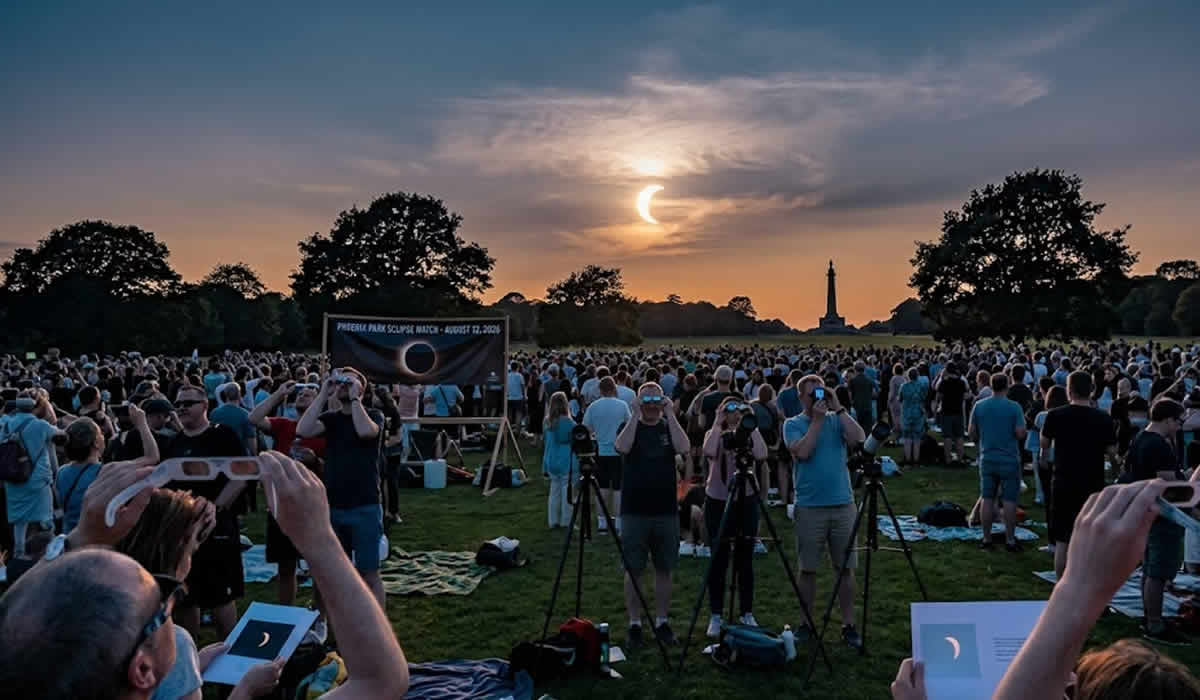
Thousands of people across Ireland paused their daily routines on Wednesday (12 August) to witness one of the country’s most spectacular astronomical events in decades. The rare partial solar eclipse darkened skies during the early evening, bringing together families, amateur astronomers and curious onlookers in parks, beaches, observatories and specially organised public viewing events across the country. The eclipse was the deepest visible from Ireland since 1999 and will not be matched again until 2090.
What happened?
A solar eclipse occurs when the Moon passes between the Earth and the Sun, partially or completely blocking the Sun’s light. While the path of totality crossed parts of Spain, Iceland and Greenland, Ireland enjoyed one of the best views of the partial eclipse anywhere in Europe.
Depending on where people were watching from, between around 93% and 98% of the Sun was obscured by the Moon. The eclipse began shortly after 6pm, reached its maximum just after 7pm and ended shortly after 8pm. Across much of the country, daylight noticeably dimmed, temperatures fell slightly and crescent-shaped shadows appeared beneath trees as sunlight filtered through the leaves.
A rare event for Ireland
Although solar eclipses occur somewhere on Earth between two and five times each year, it is uncommon for any one country to experience such a deep eclipse.
Astronomers described Wednesday’s event as the most significant solar eclipse visible from Ireland since 1999. Experts say another eclipse of similar magnitude will not be seen from Ireland until 2090, making this a once-in-a-generation opportunity for skywatchers.
Public viewing events drew large crowds
The eclipse became more than just an astronomical event. It also turned into a nationwide community experience, with astronomy clubs, observatories and science organisations hosting free public viewing sessions.
In Dublin, the Irish Astronomical Society welcomed visitors to the Phoenix Park Visitor Centre, where telescopes fitted with solar filters allowed the public to observe the eclipse safely while volunteers explained the science behind the phenomenon.
Elsewhere, ESERO Ireland organised a large family-friendly viewing event in Dundalk featuring educational activities for children, talks by astronomy experts and demonstrations explaining how eclipses occur. Similar gatherings took place in Cork, Galway and other locations around the country as communities came together to witness the spectacle.
Rush for eclipse glasses
Interest in the eclipse was so high that many retailers sold out of certified eclipse glasses before the event. Long queues formed outside some shops as people searched for the last remaining pairs.
Health authorities and astronomy experts repeatedly reminded the public never to look directly at the Sun without approved solar viewing glasses or specially filtered telescopes. Ordinary sunglasses, smoked glass and homemade filters do not provide sufficient protection and can cause permanent eye damage.
A day to remember
Wednesday’s eclipse was watched by millions of people across Europe, but Ireland enjoyed one of the finest partial views outside the narrow path of totality.
For many people, it was their first opportunity to experience a solar eclipse of this magnitude. Families, friends and astronomy enthusiasts gathered together to witness a remarkable natural phenomenon that inspired wonder and curiosity about the universe. With another eclipse of this scale not expected for many decades, 12 August 2026 is likely to be remembered as a historic day for Irish skywatchers.


