
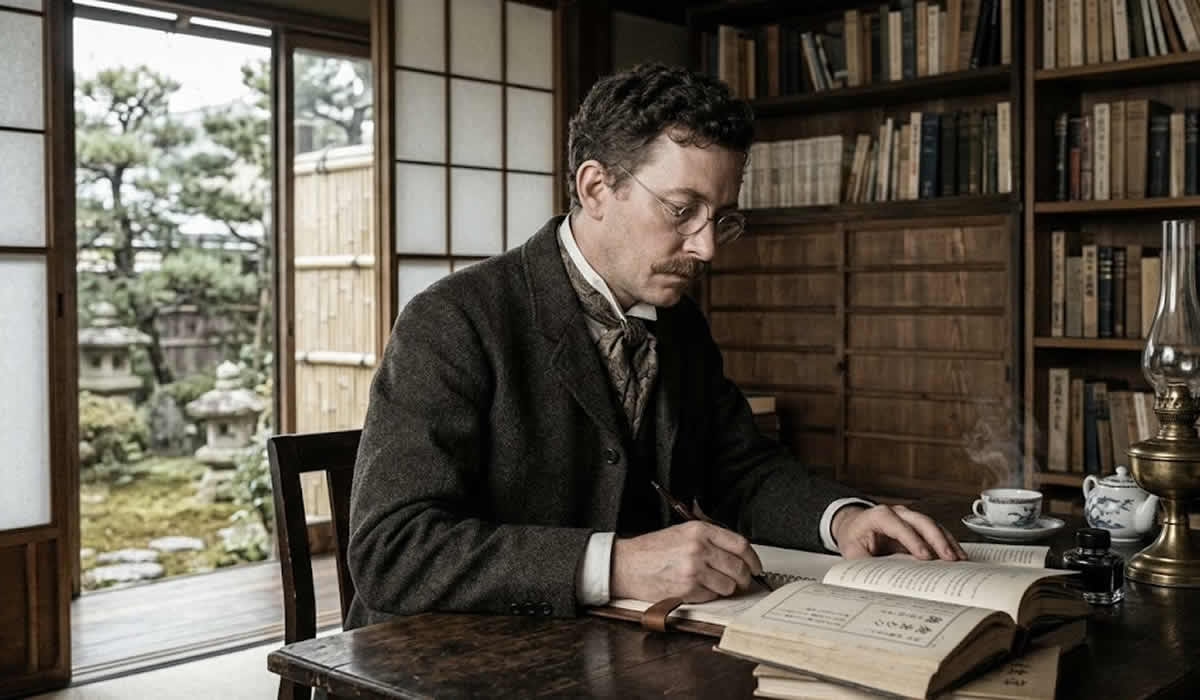
For decades, the name Patrick Lafcadio Hearn was a staple of Japanese school curricula while remaining a mere footnote in his native Ireland. Today, a cultural reawakening is firmly placing the 19th-century writer back into the Irish literary canon, celebrating a man who acted as the ultimate bridge between the mystical folklore of the West and the East.
A Childhood Forged in Irish Mist
Born in 1850 on the Greek island of Lefkada to an Irish surgeon-major and a Greek mother, Hearn’s “Irishness” was shaped by both displacement and wonder. Brought to Dublin at age two, he was eventually abandoned by his parents and raised by a Great-Aunt, Sarah Brenane.
His formative years were spent between the granite townhouses of Dublin and the seaside air of Tramore, Co. Waterford, and Cong, Co. Mayo. It was here, under the care of a Connaught nurse named Catherine Costello, that Hearn first fell in love with the supernatural. Her tales of Irish ghosts and “pishogues” (fairy spells) planted the seeds for what would later become his life’s work: the preservation of oral traditions.
In a letter to W.B. Yeats later in life, Hearn reflected on these roots, stating, “I had a Connaught nurse who told me fairy tales and ghost stories… So I ought to love Irish things, and do.”
The Wandering Ghost-Hunter
Hearn’s journey was one of perpetual exile. After a stint in Cincinnati and New Orleans—where he became a sensation for his “macabre” journalism and his marriage to Alethea Foley, a formerly enslaved Black woman—he eventually arrived in Japan in 1890.
While the West was obsessed with Japan’s rapid modernization, Hearn looked backward. He spent his years in Matsue and Tokyo meticulously recording “Kwaidan” (ghost stories) and folk legends that were being discarded in the rush toward the 20th century. He eventually became a Japanese citizen, taking the name Koizumi Yakumo, yet his biographers note that his approach to Japanese folklore was deeply colored by the Celtic “twilight” sensibility he inherited in Ireland.
Where to Find His Legacy Today
For those looking to trace the footsteps of this “Restless Spirit,” his work and memory are now more accessible than ever through these key locations and upcoming events:
- The Lafcadio Hearn Japanese Gardens (Tramore, Ireland): These gardens are a “living biography,” featuring eleven distinct areas that transition from a Victorian Garden (representing his Irish childhood) to a Greek amphitheater and finally to authentic Japanese tea houses. They host the Legends & Lore Summer Festival every July.
- The Little Museum of Dublin: Recently hosted landmark exhibitions of his first editions and personal items in collaboration with his Japanese descendants, the Koizumi family.
- The Lafcadio Hearn Memorial Museum (Matsue, Japan): Located next to his former residence, this museum houses his manuscripts, his famous telescope, and a lock of his hair.
- Kwaidan: Encounters with Lafcadio Hearn (Exhibition): This major touring exhibition features contemporary printmaking from Irish and Japanese artists. After showing at Dublin’s Farmleigh Gallery through late 2025, it is moving to the new Ireland House in Tokyo and will tour the US (Cincinnati and Virginia) throughout 2026.
The Works of Lafcadio Hearn: A Reading Guide
Hearn’s writing style is noted for its “poetic prose”—a delicate, atmospheric way of describing the mundane and the supernatural alike. Most of his bibliography is now in the public domain.
| Title | Theme | Where to Read |
| Kwaidan: Stories and Studies of Strange Things (1904) | His most famous work; a collection of Japanese ghost stories and insect studies. | Project Gutenberg |
| Glimpses of Unfamiliar Japan (1894) | A deep dive into the customs, religion, and daily life of Meiji-era Japan. | Internet Archive |
| Kokoro: Hints and Echoes of Japanese Inner Life (1896) | Essays exploring the “heart” (kokoro) of the Japanese people. | Project Gutenberg |
| Two Years in the French West Indies (1890) | Vivid travelogues from his time in Martinique before moving to Japan. | Project Gutenberg |
His “Irish” Masterpiece: The Boy Who Drew Cats
While many of his tales are strictly Japanese, his retelling of The Boy Who Drew Cats is often cited by scholars as having a distinct Irish “fairytale” structure. You can find digital versions of the original Crepe Paper Books (beautifully illustrated Japanese woodblock editions) on the International Research Center for Japanese Studies website.
Once a forgotten emigrant, Patrick Lafcadio Hearn has finally come home, proving that while he may have died as Koizumi Yakumo, the soul of his stories remained—as he once described himself—”Irish rather than English.”


