


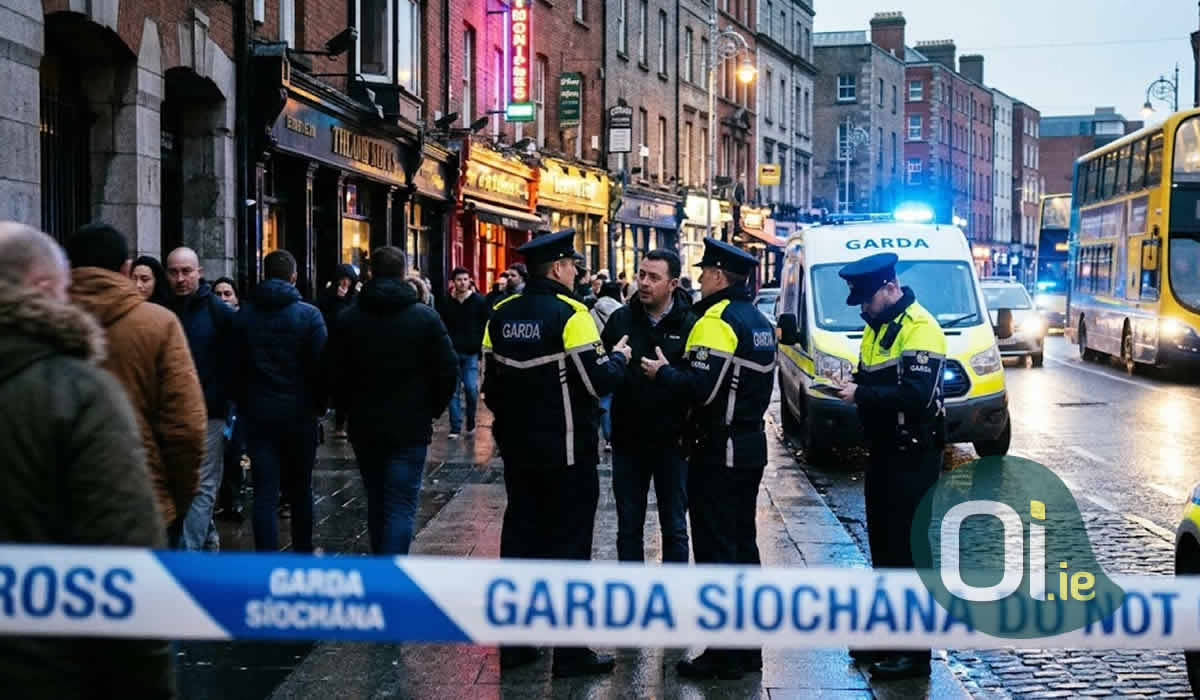
Dublin city centre could be heading towards a significant change in how it deals with crime, antisocial behaviour and public safety. Plans are being advanced to bring private security personnel onto the streets to provide additional patrols alongside An Garda Síochána.
The proposal raises an important question: has Dublin reached the point where ordinary policing and existing public safety measures are no longer enough to make people feel comfortable walking around the capital?
Reports of assaults, street robberies, drug-related activity, open drug use and antisocial behaviour have become increasingly prominent in discussions about Dublin city centre. Although most people visiting or living in the capital will never experience a serious crime, the visibility of these problems has become difficult to ignore.
What Exactly Is Being Proposed?
According to The Irish Times, a tender is being drafted to hire a private security company to provide what are being described as “safety operatives” in Dublin city centre.
The proposal follows discussions between business representatives and the new Dublin City Development Company, led by former senior civil servant Robert Watt. The company has been tasked with implementing recommendations from the Dublin City Taskforce, which was established following the November 2023 riots.
Business group Dublin Town is understood to be acting as the contracting body, with initial funding expected to come from prominent city businesses.
The proposed operatives would provide an additional visible presence on the streets and complement existing Garda resources. They would not replace the police or have the same legal powers.
Why Is Dublin Considering Private Security?
The proposal comes after years of complaints about the condition of parts of Dublin city centre, particularly around O’Connell Street, Parnell Street, Talbot Street, Abbey Street and parts of Temple Bar.
Residents, workers, retailers and tourists have raised concerns about:
- Groups engaging in aggressive or intimidating behaviour.
- Drug use and suspected drug dealing in public spaces.
- Street assaults, robberies and harassment.
- Public drunkenness and disorder.
- Persistent begging and confrontations with passers-by.
- Litter, vandalism and poorly maintained public spaces.
- People feeling uncomfortable using certain streets, particularly after dark.
One of the biggest problems is the difference between Dublin’s reputation as a relatively safe European capital and the experience people can have in particular parts of the city.
A visitor does not need to become a victim of crime to feel uncomfortable. Seeing open drug use, aggressive confrontations or threatening behaviour can be enough to discourage people from returning to an area.
Businesses are particularly concerned because an unwelcoming city centre affects tourism, shopping, hospitality and people’s willingness to spend time in Dublin.
Serious Incidents Have Added to Concerns
Several disturbing incidents in Dublin city centre over the past year have reinforced concerns about public safety. These individual cases do not prove that every part of the city is becoming more dangerous, but they illustrate the seriousness of some of the incidents taking place in busy public areas.
August 2025: Man Left Critically Injured in Temple Bar
A man in his 40s was seriously assaulted in the Temple Bar Square area in the early hours of 21 August 2025. He was taken to Beaumont Hospital in a critical condition. Gardaí subsequently arrested a man in connection with the investigation.
Garda witness appeal and incident details.
February 2026: Man Left in Critical Condition After Temple Bar Attack
A man was seriously assaulted on Cope Street in Temple Bar at approximately 12.30am on 18 February. He was taken to Beaumont Hospital in a critical condition. Two men were subsequently charged in connection with the assault.
RTÉ report on the Temple Bar assault.
June 2026: 21-Year-Old Man Dies Following City Centre Assault
A 21-year-old man died following an assault on Clarendon Street, close to Grafton Street, in the early hours of 1 June 2026. He was found in a serious condition and taken to St James’s Hospital, where he was pronounced dead. Gardaí launched a murder investigation.
RTÉ report on the fatal Clarendon Street assault.
These incidents demonstrate that the concerns are not simply about appearances or complaints from retailers. Serious violence has occurred in some of the capital’s busiest streets and entertainment districts.
Is Crime Actually Increasing in Dublin?
The picture is more complicated than headlines and social media videos might suggest.
An Garda Síochána introduced a high-visibility policing operation in Dublin city centre in March 2025. Figures published in April 2026, covering the period from April 2025 to March 2026, show the scale of the operation.
| Garda activity or offence | Change or total |
|---|---|
| Arrests over 12 months | Almost 6,500 |
| Charges and summonses | Over 13,500 |
| Public order detections | +12% |
| Drunkenness detections | +21% |
| Drug possession detections | +16% |
| Obstruction under the Drugs Act | +27% |
| Theft from person | -23% |
| Robbery from person | -33% |
| Assaults causing harm | -18% |
Source: An Garda Síochána’s April 2026 policing update.
The increase in public order and drunkenness detections does not necessarily mean those offences have become more common. More visible policing and proactive enforcement can result in more offences being detected.
Equally, the reductions in robbery and assault figures suggest that increased Garda visibility has been having a positive effect.
Nevertheless, almost 6,500 arrests in one year, averaging around 18 per day, illustrates the considerable workload involved in policing the city centre.
The issue is therefore not simply whether crime is statistically increasing. It is whether the existing arrangements are sufficient to maintain a city centre that people feel comfortable using.
What Do Other Cities Do?
Dublin would not be the first city to introduce additional personnel to improve safety and public order. However, different cities use different approaches, ranging from privately funded security patrols to dedicated municipal officers.
London, United Kingdom
London’s West End has an established private security operation funded by local businesses through the New West End Company Business Improvement District.
In May 2026, the organisation announced a £23 million private investment package to strengthen security operations and infrastructure. More than 800 businesses contribute to the organisation, which funds an expanded street security team operating around the clock.
The patrols work alongside the Metropolitan Police, local authorities and other agencies. Their purpose is to deter crime, identify problems, share intelligence and provide additional reassurance to workers, residents and visitors.
Details of London’s £23 million West End security investment.
Barcelona, Spain
Barcelona has developed a different approach, combining municipal police patrols with dedicated civic officers.
Its Civic Officer Unit operates across the city’s districts, providing information, encouraging responsible behaviour, warning people about inappropriate conduct and helping prevent conflicts in public spaces. The officers coordinate with the Guàrdia Urbana, Barcelona’s municipal police.
Barcelona also introduced tougher civic regulations in February 2026, including increased penalties for public drinking, street urination, graffiti and serious noise disturbances. Its local police carry out patrols in areas identified as having higher levels of public disorder.
How Barcelona’s Civic Officers operate | Barcelona’s updated public behaviour rules.
What Powers Would Private Security Guards Have?
This is perhaps the most important question surrounding the proposal.
Private security guards are not Gardaí. They cannot simply take over the responsibilities of the police because a private company has been contracted to patrol public streets.
Following the announcement, Dublin City Council clarified that the proposed safety wardens would not have additional statutory powers to:
- Arrest people.
- Demand identification.
- Search individuals.
- Require people to leave public streets.
- Issue fines.
- Enforce local authority bylaws.
Their role would instead centre on observation, reporting incidents, providing a visible presence and communicating with Gardaí.
This distinction matters enormously. Private security personnel should not be deciding who is allowed to use public streets or attempting to exercise powers they do not legally possess.
There are also questions about accountability, training, complaints procedures, body cameras, supervision and how operatives would interact with vulnerable people.
More details about the proposed powers and the council’s clarification.
Why Are Politicians Concerned?
Not everyone believes private security is the right answer.
Green Party councillor Janet Horner has raised concerns about what amounts to private policing of public streets, particularly given the potential civil liberties implications.
Other councillors have also called for greater scrutiny of the proposal, arguing that the public and elected representatives should have an opportunity to examine its legal basis and practical implications before a contract is awarded.
One of the biggest criticisms is that the plans were being developed without proper consultation with elected Dublin city councillors.
There is also a more fundamental question: if Dublin needs private security guards to make its streets feel safe, why isn’t the Government investing sufficiently in the public policing service?
The concern is that private security could become a cheaper substitute for properly resourced Garda patrols, rather than an additional service.
Could Private Patrols Actually Make Dublin Safer?
Potentially, yes, provided expectations are realistic.
A visible security presence could help deter opportunistic crime, discourage antisocial behaviour and ensure incidents are reported quickly. It could also provide reassurance to people who work late, tourists unfamiliar with the city and businesses that regularly deal with disruptive behaviour.
However, private security cannot solve the underlying problems associated with drug addiction, homelessness, mental health difficulties, organised criminal activity or inadequate policing resources.
Nor can guards simply move people from one street to another and declare the problem solved.
If Dublin wants a genuinely safer city centre, it needs a combination of measures:
- More permanent, high-visibility Garda patrols.
- Properly trained and supervised supplementary safety personnel.
- Better CCTV coverage and faster responses to incidents.
- More effective action against repeat offenders and violent groups.
- Better lighting, street maintenance and public infrastructure.
- Appropriate addiction, mental health and homelessness services.
- Clear public accountability for anyone employed to patrol public spaces.
The proposed private security operation should also be independently evaluated. Dubliners deserve to know how much it costs, what it achieves and whether it actually reduces crime and antisocial behaviour.
Dublin Needs Its City Centre Back
Dublin is an important European capital, a major tourist destination and home to thousands of people who rely on its city centre every day.
It should not be normal for people to plan their journeys around streets they would rather avoid, for retailers to worry about disruptive behaviour or for tourists to leave with the impression that the capital is unsafe.
There is nothing inherently wrong with businesses contributing to additional street patrols. London’s West End demonstrates that privately funded security can operate alongside public policing, while Barcelona shows how civic officers and municipal police can share responsibility for public spaces.
But there is a difference between providing extra eyes and ears on the streets and effectively outsourcing public safety.
The Government and Dublin City Council must be clear about where that line sits.
Private security might help Dublin address some of its immediate problems. But it should complement a properly funded and visible Garda presence, not become an admission that the State cannot adequately protect its own streets.
Dublin needs more than security guards in high-visibility jackets. It needs a city centre that people actually want to spend time in.


