


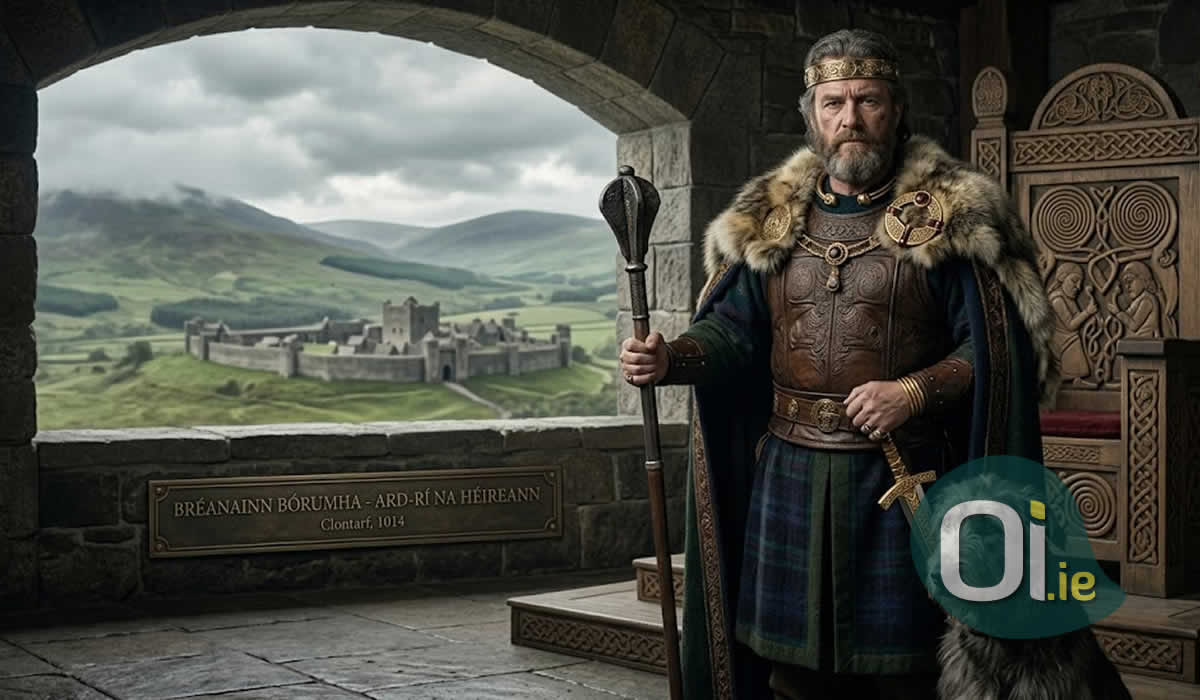
Ireland has a long monarchical history, but not in just one simple form. In early Ireland, the island was divided into many smaller kingdoms, each with its own ruler, and some kings claimed the title of High King of Ireland, or Ard Rí. Later, Ireland became part of the British crown’s system of rule, first as a lordship and then as the Kingdom of Ireland.
Today, the Republic of Ireland does not have a monarchy. Northern Ireland, however, remains part of the United Kingdom, so it is still under the British monarchy.
What Ireland Had Before
Ancient Ireland was not one kingdom ruled from a single palace. Instead, it was a patchwork of túatha, or small kingdoms, each led by its own king. Over these sat larger provincial kingdoms, and in some periods a High King at Tara claimed wider authority.
The five traditional provinces are Leinster, Munster, Connacht, Ulster, and Meath, and they were central to medieval political life. These regions mattered because kingship in Ireland was tied to land, kinship, and local power, not a modern central state.
Famous Irish Kings
The most famous Irish king is probably Brian Boru. He became High King of Ireland in the early 11th century and is remembered for strengthening Irish unity and confronting Viking power. His death at the Battle of Clontarf in 1014 made him a legendary figure in Irish memory.
Other notable High Kings include Máel Sechnaill and Ruaidrí Ua Conchobair. Máel Sechnaill is associated with resistance to Viking pressure, while Ruaidrí Ua Conchobair is often described as the last High King before the Norman invasion changed the political order. These names matter because they show that Ireland’s monarchy was native and politically complex long before English rule.
Queens and Royal Women
Irish history also has powerful women who are often described as queens, warriors, or dynastic figures. One of the best-known is Medb, or Maeve, a legendary queen associated with Connacht and Irish mythology. Another famous figure is Grace O’Malley, the Pirate Queen, who resisted English power in the 16th century.
Then there are the women linked to royal politics rather than myth. Gormflaith ingen Murchada married both Viking and Irish kings, including Brian Boru, and became part of one of the best-known royal stories in medieval Ireland. Aoife MacMurrough also became a major dynastic figure after her marriage into the Anglo-Norman world.
The Regions and Dynasties
If you want to understand Irish monarchy, you have to understand the regions. Power was fragmented across provincial kingdoms such as Munster, Leinster, Connacht, Ulster, and Meath, with rival dynasties competing for dominance. In medieval Ireland, kingship was as much about regional control as it was about national authority.
Some dynasties became especially important, including the Uí Néill in the north and midlands, the Uí Chennselaig in Leinster, and ruling families in Munster and Connacht. This is why Irish monarchy looks less like a neat line of monarchs and more like a shifting chessboard of competing families and territories.
When the Crown Took Over
The Norman invasion of Ireland in the 12th century changed everything. Henry II became Lord of Ireland in 1171, and English influence grew over time as Anglo-Norman lords carved out power across the island. In 1542, Ireland was declared a kingdom under Henry VIII, tying it more directly to the English crown.
From that point, Irish monarchy was no longer a native system of local kings and High Kings. It became part of the wider British imperial and dynastic system, eventually leading to the Act of Union in 1800 and later the breakaway of most of Ireland in the 20th century. That is the turning point where Ireland stops being a monarchy story and becomes a republic story.
Why It Still Fascinates
Ireland’s monarchical past is dramatic because it mixes history, legend, invasion, resistance, and identity. It has warrior kings, pirate queens, regional dynasties, and a royal system that changed repeatedly over more than a thousand years. That makes it perfect for shareable, high-interest content.


