
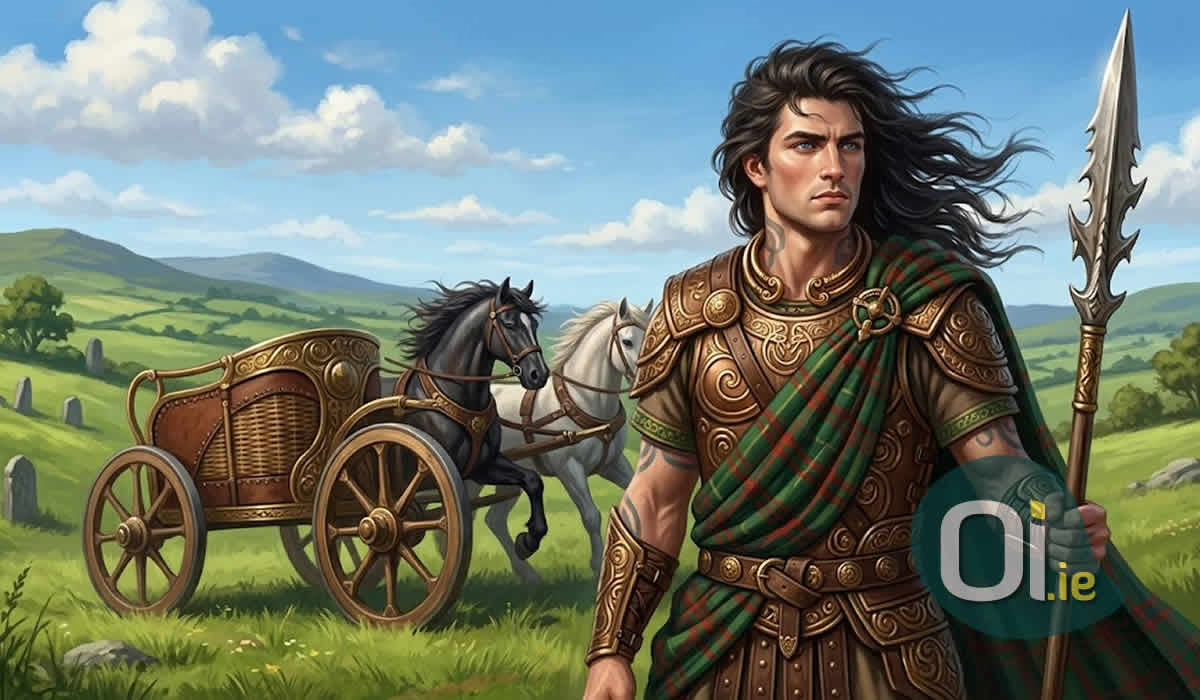
Few figures in Irish mythology are as famous, fearsome or tragic as Cú Chulainn. Known for his extraordinary strength, fierce loyalty and remarkable courage, he is one of the central characters in Ireland’s ancient heroic stories. His adventures have been passed down through generations, helping to preserve a rich tradition of Irish storytelling that continues to fascinate people today.
From his childhood as a gifted young warrior to his legendary defence of Ulster, Cú Chulainn’s story is filled with supernatural powers, epic battles, personal sacrifice and tragedy.
But who was Cú Chulainn, and why does his legend remain such an important part of Irish culture?
Who Was Cú Chulainn?
Cú Chulainn, sometimes written as Cuchulain or Cuchulainn in English, is a legendary hero from early Irish literature. He is the central figure in many stories belonging to the Ulster Cycle, one of the major collections of Irish mythology.
His name is commonly translated as the Hound of Culann, referring to a famous incident from his childhood that would give him the name by which he became known throughout Irish legend.
According to traditional accounts, he was born Sétanta. His mother was Deichtine, who was connected to the royal household of Ulster, while his father is identified as Sualtam in some accounts. Other versions connect his supernatural origins to the god Lugh.
The stories place Cú Chulainn in a mythical version of ancient Ireland, where kings, warriors and supernatural beings inhabit a world shaped by honour, rivalry, prophecy and warfare.
Although the tales are set in a distant past, the surviving written versions were recorded during the medieval period, drawing on storytelling traditions that may be considerably older.
How Cú Chulainn Got His Name
One of the best-known stories about Cú Chulainn explains how he earned his famous name.
As a young boy, he was known as Sétanta. One day, he travelled to the home of Culann, a powerful smith, where a gathering was taking place.
Culann had a fierce guard dog protecting his property. When Sétanta arrived, the animal attacked him. Despite his young age, the boy managed to defeat the enormous hound.
Culann was devastated by the loss of his protector, so Sétanta offered to take the dog’s place until another guard animal could be raised.
From that moment, he became known as Cú Chulainn, the Hound of Culann.
The episode reveals the qualities that would define him throughout his life: extraordinary bravery, physical ability and a strong sense of responsibility towards others.
A Warrior Unlike Any Other
Cú Chulainn’s reputation was built on feats that went far beyond the abilities of an ordinary warrior.
In the mythology, he possessed exceptional strength, speed and fighting skills. His weapons and chariot became associated with his legendary exploits, while his ability to face entire groups of opponents made him one of the most formidable figures in the Ulster Cycle.
One particularly striking feature of his character was his battle frenzy, often described in English as a battle-spasm or warp-spasm.
During these episodes, Cú Chulainn’s body transformed into a terrifying and unnatural form. His appearance became grotesque, his strength increased dramatically, and he became an almost unstoppable force on the battlefield.
These descriptions are among the most extraordinary passages in Irish heroic literature. They portray a warrior whose abilities are so powerful that they push beyond the boundaries of the human world.
Yet Cú Chulainn was not simply a figure of brute strength. His stories also explore loyalty, friendship, pride and the terrible consequences of violence.
The Táin Bó Cúailnge: His Greatest Adventure
The most famous story associated with Cú Chulainn is the Táin Bó Cúailnge, usually translated as the Cattle Raid of Cooley.
This epic tells the story of Queen Medb of Connacht, who launches an invasion of Ulster to seize the Brown Bull of Cooley, a prized animal whose ownership becomes the focus of a conflict between rival kingdoms.
The warriors of Ulster are unable to defend their territory effectively because of a supernatural affliction affecting them. Cú Chulainn, however, is able to fight, leaving him to face the invading forces largely alone.
He challenges opposing warriors to single combat at strategic crossings and delays the advance of Medb’s army while his people remain unable to fight.
The story presents a series of extraordinary confrontations, showcasing his skill, courage and determination. It also explores the personal cost of defending one’s homeland when the odds are overwhelmingly against you.
The Táin is one of the most important works of early Irish literature and remains central to the country’s mythological heritage.
The Tragic Battle Against Ferdiad
Among the most memorable episodes in the Táin is Cú Chulainn’s confrontation with Ferdiad, a warrior who had once trained alongside him.
The two had been foster-brothers and companions, learning the arts of combat under the warrior woman Scáthach. Their shared history makes their eventual battle especially painful.
During the invasion, Medb persuades Ferdiad to fight Cú Chulainn. Neither man wants to kill the other, but their circumstances and loyalties bring them into conflict.
They fight over several days, using an array of weapons and demonstrating extraordinary skill. Despite their friendship, neither can escape the demands placed upon them.
Eventually, Cú Chulainn kills Ferdiad with his legendary spear, the Gáe Bolga.
The victory is devastating rather than triumphant. Cú Chulainn has defeated a formidable opponent, but that opponent was also someone he loved and respected.
The episode gives the mythology an emotional depth that goes beyond spectacular battles. It is a story about friendship, divided loyalties and the human cost of war.
Scáthach and the Training of a Hero
Another important figure in Cú Chulainn’s life is Scáthach, a legendary warrior woman who trains him in combat.
According to the stories, Cú Chulainn travels to learn from her, facing dangerous challenges before becoming one of her pupils.
Under her instruction, he develops the skills that later distinguish him from other warriors. His training includes mastering weapons, fighting techniques and extraordinary feats of physical ability.
Scáthach’s role is significant because she is not simply a supporting character. She is a formidable warrior and teacher whose knowledge helps shape the hero’s destiny.
Her place in the story also highlights the presence of powerful female figures throughout Irish mythology, including warriors, queens and supernatural beings whose decisions can change the course of events.
Emer and Cú Chulainn’s Love Story
Although Cú Chulainn is remembered primarily as a warrior, his mythology also includes romance.
Emer, the daughter of Forgall Monach, is his best-known wife or partner in the traditional stories. She is portrayed as intelligent, strong-willed and worthy of a hero whose reputation is matched by few.
Their relationship features courtship, obstacles and the challenges of living with a warrior whose life is dominated by danger and conflict.
Emer is often remembered as one of the most significant women in Cú Chulainn’s life. Her story provides a contrast to the violence of his adventures and reminds readers that the hero’s world also involved family, affection and personal commitments.
How Did Cú Chulainn Die?
The end of Cú Chulainn’s story is as dramatic as the life that preceded it.
His enemies eventually exploit his vulnerabilities and the supernatural restrictions known as geasa that shape his destiny. In Irish tradition, a geis is an obligation, prohibition or taboo that a person is expected to observe. Breaking one, or being forced into a situation where conflicting obligations cannot be reconciled, can have devastating consequences.
Cú Chulainn is drawn into circumstances that weaken his position, and he is ultimately mortally wounded.
In one of the most memorable images in Irish mythology, he ties himself to a standing stone so that he can die on his feet rather than fall helplessly to the ground. His enemies hesitate to approach because they fear he may still be alive.
Only when a raven lands on his shoulder do they understand that the great warrior is dead.
The scene has become one of the most enduring images associated with Cú Chulainn. It captures his refusal to surrender, even in the face of death, while bringing a tragic end to a life defined by extraordinary courage.
Where Is Cú Chulainn Connected to Ireland?
Cú Chulainn’s legend is closely associated with Ulster, particularly the landscape and traditions of what is now Northern Ireland and the northern part of the island.
Emain Macha, the legendary royal centre of the Ulster kings, is traditionally associated with Navan Fort near Armagh. The archaeological site provides a tangible connection to the landscape in which many Ulster Cycle stories are set, although the mythological events themselves cannot be treated as verified history.
The Cattle Raid of Cooley also connects the legend with the Cooley Peninsula in County Louth, a landscape that gives its name to the epic.
Across Ireland, Cú Chulainn has inspired statues, artwork, literature and public memorials. His image has also been used in different political and cultural contexts, particularly in discussions of Irish identity, sacrifice and national heritage.
These modern interpretations sometimes differ sharply, demonstrating how a mythological figure can acquire new meanings long after the original stories were recorded.
Was Cú Chulainn a Real Person?
There is no reliable historical evidence establishing that Cú Chulainn existed as a real individual.
His story belongs to Irish heroic mythology, combining supernatural events, legendary characters and exaggerated feats of warfare. The tales may preserve elements of older traditions, but historians cannot verify the hero’s life as historical fact.
The surviving versions of the Táin Bó Cúailnge were recorded in medieval manuscripts, including the Book of the Dun Cow and the Book of Leinster.
These manuscripts are important cultural and literary records. They show how Irish storytelling traditions were preserved and reshaped over time, allowing stories from an imagined heroic past to survive into the modern era.
Rather than viewing Cú Chulainn as a straightforward historical figure, it is more accurate to understand him as one of the defining heroes of Ireland’s mythological tradition.
Why Cú Chulainn Still Matters Today
Cú Chulainn remains one of the most recognisable characters in Irish mythology because his story combines spectacle with tragedy.
He represents courage, loyalty and a willingness to defend others, but his life also reveals the dangers of pride, violence and a destiny that cannot easily be escaped.
His adventures have influenced Irish literature, visual art, popular culture and the way people imagine the country’s ancient past.
For readers discovering Irish mythology for the first time, Cú Chulainn offers an entry point into a much wider collection of stories involving kings, queens, warriors, gods and supernatural beings.
His legend also provides a reminder of the importance of oral storytelling in Ireland. Long before modern books, films and television, stories like these were passed between generations, evolving as storytellers gave them new life.
The Enduring Legend of Cú Chulainn
From the boy who defeated Culann’s hound to the warrior who stood against an invading army, Cú Chulainn occupies a unique place in Ireland’s cultural imagination.
His story is one of extraordinary achievements, fierce friendships and an ultimately tragic fate. It is also a window into the storytelling traditions that helped shape Irish literature and folklore.
Whether encountered through the Táin Bó Cúailnge, modern retellings or the landscapes associated with the Ulster Cycle, Cú Chulainn remains a powerful symbol of Ireland’s mythological heritage.
Centuries after the surviving manuscripts were written, the Hound of Ulster continues to stand as one of the great heroes of Irish legend.


