
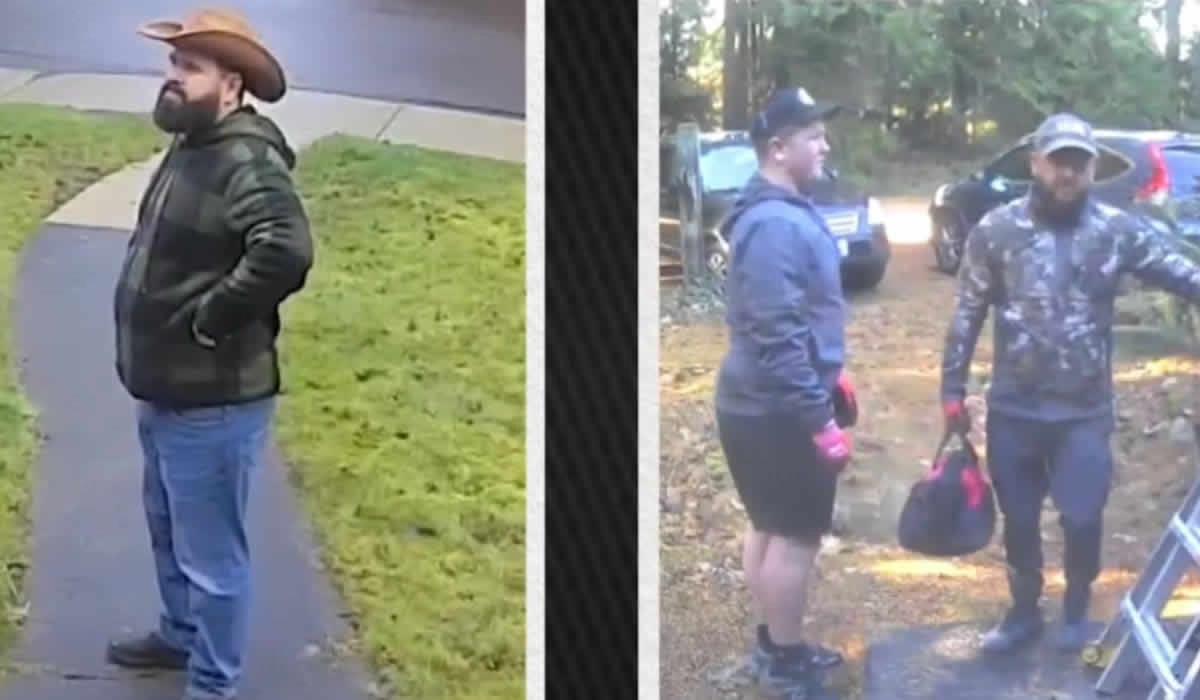
An Irish accent, a knock at the door and an offer to fix your driveway. It sounds harmless enough. But across parts of the United States, homeowners are reporting a disturbing pattern of construction fraud involving Irish nationals, bogus paving companies, fabricated building problems and demands for thousands of dollars. Some victims have lost their life savings.
What began as a familiar travelling-contractor pitch has become a serious law-enforcement issue in several American states. Police departments, federal investigators and local television journalists have been investigating groups of travelling operators accused of exploiting homeowners through sham roofing, tarmac, masonry and driveway businesses.
The allegations are not simply about poor workmanship or a cowboy builder doing a bad job. In documented cases, investigators describe deliberate deception, unnecessary repairs, intimidating sales tactics, unfinished projects and money disappearing before the promised work is completed.
And there is an uncomfortable Irish connection.
The American construction scam with an Irish connection
American authorities have increasingly referred to the activity as travelling conman fraud. The groups involved are described by US law enforcement as Irish or UK nationals who travel between American cities, often using temporary accommodation and short-lived business identities.
The FBI’s description, reproduced in US federal court documents, outlines a recognisable pattern. Individuals approach homeowners, often older residents, claiming to have spare materials from another nearby job or having noticed damage to a property.
The initial offer can sound remarkably reasonable. A driveway needs sealing, a few bricks need replacing, a chimney needs attention or a roof requires a minor repair.
Once the homeowner agrees, the situation can change dramatically.
Additional problems suddenly appear. A small repair becomes a major structural issue. The homeowner is told the property could suffer serious damage unless immediate work is undertaken. Prices increase, pressure builds and substantial payments are demanded.
In some cases, the work is allegedly unnecessary. In others, it is poorly completed or never finished.
The US Department of Justice has described these operations as groups rather than one centrally organised organisation. That distinction matters, but it does not make the scale of the problem any less serious.
Read the US Department of Justice’s explanation of the travelling conmen operation.
The bogus tarmac and driveway businesses
One of the best-known versions of the scam involves driveway paving and tarmac sealing.
The approach is simple. A homeowner is told that contractors have just finished another job nearby and have leftover asphalt or sealing material. Rather than waste it, they offer to complete a driveway at a discounted price.
It is an effective sales pitch because it creates the impression of a limited-time bargain.
The business may have a generic name, professionally printed flyers, a telephone number, business cards and even a website. None of those things necessarily proves that the operation is legitimate.
Boston Police have repeatedly warned residents about companies using names such as A1 Paving and City & Town Paving. They describe unsolicited approaches, leftover-material stories, escalating costs and demands for payments made out to individuals rather than registered businesses.
In August 2024, police in Milford and Hopkinton, Massachusetts, also warned residents about a company calling itself Green Paving & Masonry. Police said the operation was taking money upfront and disappearing without completing the promised work.
The existence of a legitimate business with a similar name makes the problem even more serious. Innocent contractors can find themselves associated with fraudsters simply because the scammers have chosen a familiar-sounding company name.
See the Milford and Hopkinton police warnings.
The roofing scam that exposed the scale of the operation
The problem is not confined to driveways.
In Denver, Colorado, homeowners were approached by two Irish nationals, Dean Morgan and John McNamara, who allegedly presented themselves as roofing contractors.
The reported approach was particularly brazen.
According to homeowners interviewed by CBS News Colorado, the men claimed to have noticed problems with roofs while passing properties. They offered to inspect or repair the damage, sometimes suggesting that the initial work would be free in exchange for a tip.
Homeowners subsequently alleged that the men planted worms beneath roof shingles, photographed them and presented the images as evidence of an infestation requiring urgent repairs.
Some residents paid thousands of dollars. Others said their roofs had been damaged in the process.
The operation was associated with business names including Uptown Remodelling LLC and Mary Jim’s Roofing & Masonry.
Following the television investigation, additional homeowners came forward. Morgan and McNamara were arrested at JFK Airport in New York in May 2024, as they were preparing to leave for Dublin. They faced theft and racketeering charges.
The case demonstrated how quickly a local neighbourhood complaint could develop into a much wider investigation.
Read the CBS News Colorado investigation.
Rhode Island: More than $2.5 million taken from homeowners
One of the most striking cases involved Dublin man John O’Brien.
O’Brien travelled to the United States in 2021 on a tourist visa and established himself as a building contractor operating in Massachusetts and Rhode Island.
His business, Traditional Masonry & Construction, was used to approach homeowners and sell repair work.
Federal investigators alleged that homeowners were persuaded to pay for repairs that were unnecessary, improperly represented or never adequately completed.
In April 2025, the US Department of Justice announced that O’Brien had been charged in connection with an alleged multi-state fraud operation. Investigators estimated that the scheme had defrauded homeowners of more than $1 million at that stage.
The eventual financial picture was considerably worse.
In April 2026, The Irish Times reported that O’Brien had been sentenced to four years and eight months in prison after pleading guilty. He had defrauded more than 100 homeowners of an estimated $2.5 million.
One victim, a retired school crossing guard, reportedly paid more than $90,000, including money from a life insurance account.
Another homeowner was persuaded to pay for increasingly expensive work after being told that structural problems had been discovered.
This was not a case of a contractor simply failing to meet expectations. It was a criminal fraud operation that destroyed people’s financial security.
Read the Irish Times investigation into the O’Brien case.
Seattle: A multi-million-dollar investigation
The latest major development has been in the Pacific Northwest.
In September 2026, RTÉ’s Prime Time reported that American federal agencies, including Homeland Security, were involved in a multi-state investigation into an Irish construction fraud operation.
Seattle police told RTÉ that they had identified approximately 30 suspected individuals connected with the operation in the Pacific Northwest.
Police estimated that victims in Seattle alone had lost approximately $15 million. The wider investigation also involved Washington State and Oregon, with similar complaints reported in Colorado, Utah and California.
Some victims reportedly lost hundreds of thousands of dollars.
One Seattle homeowner, David Diedrick, described how a man approached his partner outside their home and offered to repair their chimney. An initial estimate of $2,300 subsequently increased as the supposed contractors identified further problems.
The pressure continued as additional work was proposed and more money demanded.
Investigative journalist Andie Judson of KING 5 said she had spoken to numerous victims, including one whose losses approached $700,000 to $1 million.
RTÉ also reported that investigators were examining suspected money laundering through businesses in New York and transfers into cryptocurrency overseas.
The investigation is particularly significant because police say some suspects previously deported from the United States have allegedly returned and continued operating under different circumstances.
Read RTÉ’s September 2026 investigation.
Who are the Irish Travellers?
Irish Travellers are an indigenous ethnic minority originating in Ireland. They have a distinct cultural identity, history, traditions and language, and are recognised as a separate ethnic group in Ireland.
They are not the same as Romani people, despite similarities in aspects of traditional nomadic life.
Their origins have been debated by historians and researchers for generations. Some theories link their development to periods of economic displacement, including the Great Famine. Others suggest that Traveller communities existed much earlier, possibly developing over centuries through separation from settled Irish society.
Genetic research published in Scientific Reports in 2017 found evidence that Irish Travellers share ancestry with the wider Irish population but developed as a distinct population before the Great Famine of 1845-1852.
The research also identified a distinct Traveller language known as Shelta, with Cant and Gammon among its forms.
Historically, many Traveller families earned their living through occupations that suited a mobile way of life. These included horse trading, tinsmithing, seasonal agricultural work, dealing in scrap metal, travelling entertainment and general trades.
Travelling was not simply a lifestyle choice. It was closely connected to how families earned a living, maintained relationships and preserved their culture.
Read the 2017 scientific research into Traveller origins.
How did Irish Travellers establish communities in America?
Irish Traveller communities have existed in the United States for generations.
One of the best-known settlements is Murphy Village, near North Augusta in South Carolina. It developed as a distinct Irish Traveller community during the 1960s and has become an important centre for Traveller families in America.
Other established communities have developed in Tennessee and Texas.
The American Traveller population is difficult to quantify accurately because the US Census does not separately recognise Irish Travellers as a distinct ethnic category.
Academic estimates vary considerably, and the community has maintained strong family and cultural connections with Ireland and the wider Irish Traveller diaspora.
American Traveller communities are not synonymous with the travelling construction fraud operations. Most people who identify as Irish Travellers are not involved in criminal activity, just as Irish people generally cannot be held responsible for crimes committed by Irish nationals abroad.
However, the existence of established communities, family networks and transatlantic connections provides important context for understanding how some travelling groups can operate across different American states.
Read the geographical and anthropological study of Murphy Village.
Why is the scam so difficult to stop?
The geographical nature of the operations creates serious problems for American police.
A group can approach homeowners in one town, collect payments, move to another county and then operate in another state. Victims may not realise they have been defrauded until the contractors have disappeared.
Different police departments may initially treat complaints as isolated incidents rather than parts of a wider operation.
Business names can be changed, telephone numbers abandoned and websites created or removed. Some operators allegedly use tourist visas to enter the country, despite not having permission to work.
The FBI’s description of the operation also highlights the use of hired labourers, misleading business identities and work that is incomplete, unnecessary or deliberately damaging.
The result is a particularly difficult form of fraud to investigate because it combines local property crime with international travel, financial transfers and multiple identities.
What American homeowners should look out for
The warnings from American police are remarkably consistent.
| Warning sign | What to watch for |
|---|---|
| Leftover materials | An unsolicited offer to use spare tarmac or roofing materials |
| Cheap initial quote | A suspiciously low price that increases once work starts |
| Urgent repairs | Claims that your roof, chimney or foundations are in immediate danger |
| Unrequested inspection | Contractors identifying problems you never knew existed |
| Cash or personal cheques | Payments requested in an individual’s name rather than a verified business |
| No registration | No verifiable business registration, insurance or permits |
| Pressure | Intimidation or demands for immediate payment |
Boston Police advise homeowners to obtain at least two independent estimates, verify licences and insurance, and check whether permits are required.
A legitimate contractor should have no difficulty providing a registered business identity, references, insurance details and a written quotation.
The safest response to an unsolicited offer is to decline it and contact an established local contractor independently.
The uncomfortable question for Ireland
There is a wider reputational issue here that Ireland cannot simply ignore.
When Irish nationals repeatedly appear in American investigations involving organised home-improvement fraud, it reflects badly on the country. When victims describe Irish accents, Irish business operators and groups travelling between American states, the association becomes difficult to avoid.
But the answer is not to pretend the problem does not exist, nor to label an entire ethnic minority as criminals.
The distinction is straightforward: people who organise fraud should be identified, investigated, prosecuted and, where appropriate, deported. Victims deserve their money back wherever possible, and authorities should cooperate across borders rather than allowing suspects to exploit differences between jurisdictions.
Irish Travellers have a legitimate cultural identity and a long history that deserves to be understood. That does not place anybody above the law.
Equally, respect for an ethnic community should never become an excuse for ignoring documented criminal behaviour by individuals or organised groups associated with it.
The American homeowners who have lost their retirement savings do not need a lecture about political correctness. They need their cases investigated, their money recovered and the people responsible held accountable.
And if a stranger turns up at your door offering cheap tarmac because he has some left over from a job down the road, it might be worth asking yourself why he is so desperate to sell it.


